Why I started making felt art (and why you should too)
- Francesca
- Apr 17
- 4 min read
There is a particular kind of tiredness that has nothing to do with sleep. It is the tiredness of a full inbox, of back-to-back calls, of decisions that pile up before you have finished your morning coffee. It is the tiredness of a mind that never quite stops.
I know that tiredness well. And for a long time, I did not have a good answer to it.
A small flat, a tight budget, and a lot of colour
When I moved to Hong Kong, my world got smaller in the most literal sense. A tiny flat, a new city, and not much room — financially or physically — for the hobbies I had left behind. I had always loved DIY projects. Making things with my hands had always felt natural to me. But in that moment of transition, I had to start from scratch.
I found myself spending time online, browsing blogs and the DIY shops I had always loved. That is where I first encountered felt. Soft squares of fabric in every colour imaginable, inexpensive, easy to store, and endlessly versatile. It did not ask for a workshop or a big investment. It just asked for a little time and a little curiosity.
So I started.
The thing nobody tells you about making something by hand
I expected a hobby. What I found was something closer to relief.
The first time I sat down with a piece of felt and a simple idea in mind, something shifted. Not dramatically — there was no sudden epiphany. It was quieter than that. I noticed that for the first time in hours, I was thinking about exactly one thing. The shape in front of me. The colour I wanted next to it. Whether to add a small detail or leave it as it was.
That is the feeling I keep coming back to: the ability to focus on one thing at a time, with a clear outcome in mind, but with complete freedom over every step along the way. Nobody is waiting on my decision. Nobody needs a report. I can change direction at any moment, and the only person it affects is me.
After a long day of managing complexity and answering to deadlines, that kind of quiet autonomy is not a small thing. It is, I have come to realise, exactly what I needed.
Why felt, specifically
I have tried other creative outlets over the years. Some required too much space. Others too much skill before you could enjoy them. Some were relaxing in theory but frustrating in practice when the result did not match the vision.
Felt is forgiving. It does not fray when you cut it. It holds its shape. The colours are vivid and honest — what you see is what you get. And there is something deeply satisfying about the tactile quality of working with it. Your hands are busy. Your body is present. Your mind, for once, is not running three conversations at once.
For someone whose daily work lives largely in the abstract — in spreadsheets, logistics chains, emails, and decisions — there is something genuinely grounding about holding a finished object that did not exist an hour ago. Something you made. Something small, and imperfect, and entirely yours.
What it did for me over time
I will not pretend that felt art solved everything. Stress is still stress. Long days are still long. But I noticed, gradually, that the evenings I sat down to work on a small project were the evenings I slept better. The ones where I arrived at the next morning feeling slightly more like myself.
It gave me a ritual. A boundary between the part of the day that belongs to work and the part that belongs to me. Something that asked nothing of me except attention — and gave back, in return, a small and steady sense of calm.
I also noticed something I did not expect: a growing sense of confidence. Not the loud, professional kind. Something quieter. The knowledge that I can start with an idea, work through it step by step, and arrive at something real. That I am capable of more than I sometimes give myself credit for.
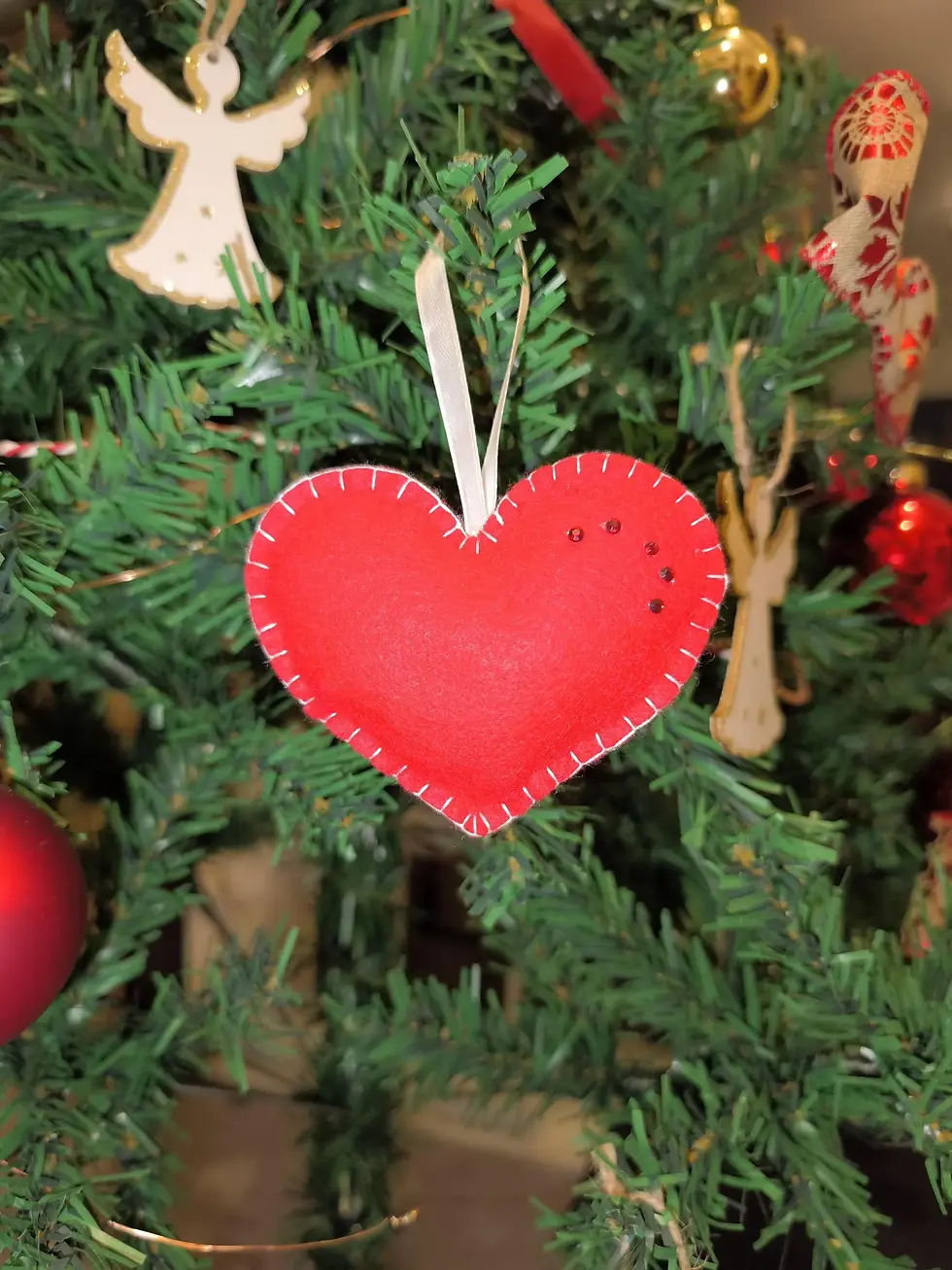
One moment that stayed with me: I made a set of small felt hearts to hang on my Christmas tree. It sounds simple, and it was — but when I stepped back and looked at the finished tree, with those little handmade hearts among the branches, I felt something that I had not expected. A quiet satisfaction that was different from finishing a project at work, different from ticking something off a list. This was something I had made for no reason other than to make it. It was there because I had wanted it to be there. And that, I realised, was enough.
Why I think you should try it too
You do not need to be artistic. You do not need experience, a big space, or an expensive kit. You need very little, in fact — a few pieces of felt, some basic tools, and the willingness to start with something simple.
What you might find, as I did, is that the simplicity is the point. In a life full of complexity, there is real value in an activity that gives you one clear thing to focus on, a visible result to work toward, and the freedom to make every decision yourself with no consequences beyond the thing in front of you.
That is not nothing. In fact, for many of us, it might be exactly what we are missing.
If you are curious about where to start, I have put together a few simple felt kits designed for beginners — a felt heart, a felt star, and a small watercolour guide for those who want to explore further. They are the kinds of projects I wish I had had when I was starting out in that small Hong Kong flat, looking for something to make with my hands.
Start small. Make something. See how it feels.


Comments